

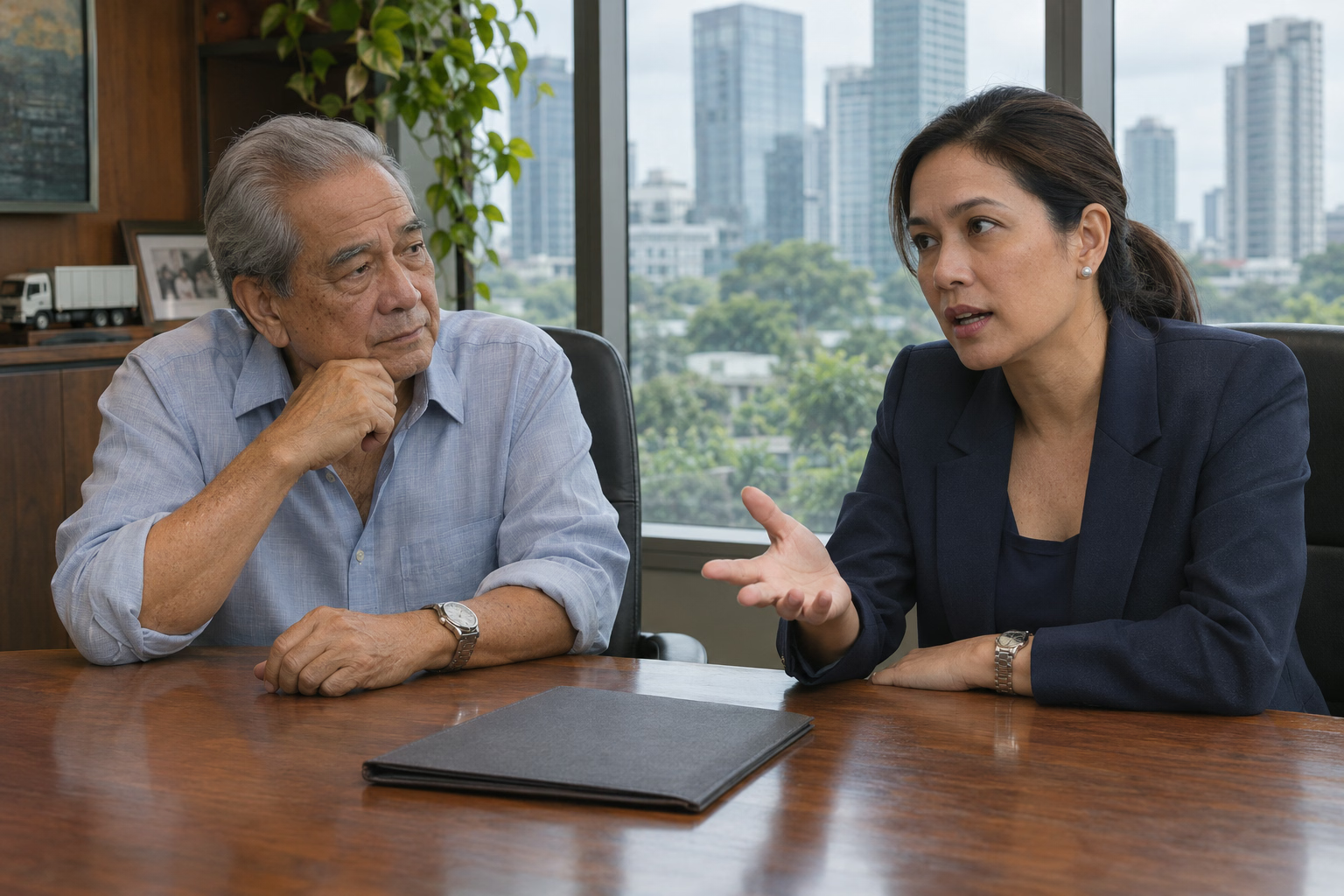
Philippine families consistently rank among the most committed in Asia to the idea of generational wealth preservation. They are also among the least prepared to execute it. A 2026 study by UnionBank Private and Swiss wealth manager Lombard Odier found that 80 percent of Philippine high-net-worth respondents identified preserving family wealth across generations as their main goal—the highest share among Asia-Pacific markets surveyed and well above the regional average of 64.2 percent.
Yet only 16.7 percent said they had a full succession plan in place, and just 10 percent said their families were fully aligned on the transition.
The Confidence Gap
The same study exposed a quiet anxiety beneath the optimism. Only 14.3 percent of Philippine respondents said they were “very confident” in the next generation’s ability to handle family wealth, compared with 16.7 percent across Asia-Pacific. In other words, the cohort that talks most about legacy is among the least confident that the heirs are ready to carry it.
That confidence gap is not necessarily a verdict on the next generation’s competence. It more accurately reflects the absence of a structured handover process. Confidence in succession is rarely built through talent alone; it is built through exposure, delegated authority, and explicit decision rights. When those are withheld until the founder exits, readiness is measured in potential rather than in proof.
Structure, Not Sentiment
One in two Philippine respondents cited intergenerational challenges, differing visions for the future, and resistance to change among senior family members as major concerns. These are governance problems dressed as personality problems. Families that lack a forum for resolving disagreement default to avoidance, and avoidance defers the very conversations that would build alignment.
The study found a measurable relationship between professional advice and family alignment. Across Asia-Pacific, 87.5 percent of respondents who receive professional advice said their families have some degree of alignment, compared with 57.8 percent among those who do not receive advice. Among respondents without advice, 50 percent identified the absence of a formal structure as a significant challenge in family governance, compared with 17.2 percent among those who receive advice.
That finding matters because Philippine succession planning is often treated as a legal formality—a will, a transfer document, a tax computation. But the data suggests that the binding constraint is organizational: families need a constitution, a governance council, a clear entry policy for family members, and a timetable for transferring authority before the founder leaves.
Why the Gap Persists
The planning deficit is not driven by lack of resources. The families surveyed are high-net-worth by definition. It is driven by the emotional cost of confronting mortality, the fear of appearing to choose favorites, and the cultural premium placed on harmony over explicit rules. The result is a paradox: families that prioritize unity avoid the very conversations that would protect it.
A family that enters succession without a plan does not avoid conflict. It merely postpones the moment when conflict becomes unavoidable—and by then, the founder’s authority is no longer available to contain it.











Leave a Reply