


The Philippine information technology and business process management sector enters 2026 with a familiar headline number and an unfamiliar strategic problem. Revenue is expected to approach $42 billion this year, with headcount targets near 1.97 million under the Industry Roadmap 2028. Yet the same AI tools that are driving demand for digital services are also eroding the language-and-accent advantage that built the industry.
The $42 Billion Baseline Is Holding—For Now
IBPAP president Jonathan “Jack” Madrid describes the industry as “cautiously optimistic,” pointing to steady investor inquiries and expansion plans from existing locators. The 2026 revenue projection, while characterized as a personal estimate rather than an official forecast, aligns with the roadmap’s baseline. The sector still contributes roughly 8.5% of GDP and remains one of the country’s largest export earners.
But the composition of that revenue is shifting. Voice-based customer service, the historical backbone of Philippine BPO, faces the most direct exposure to AI-driven automation. The Contact Center Association of the Philippines has acknowledged that AI-powered tools can now neutralize accents and improve speech clarity, making Eastern Europe, Latin America, and Africa viable alternatives for voice work. The Philippines is no longer competing only against India; it is competing against every English-capable market with a fiber connection.
Regional Talent Corridors Are Absorbing the Growth
The industry’s geographic diversification is one of its more underappreciated strengths. TP opened its second Davao site in January 2026, a PEZA-accredited hub in a city with over 100,000 IT-BPM professionals and the largest talent pool in Mindanao. Alorica expanded into Cagayan in Northern Luzon, citing the province’s English-speaking workforce and educational institutions. Altius Inspiro, a KDDI-affiliated operator, opened a Dumaguete hub serving US, Japanese, and global retail clients.
These moves matter because they reduce the industry’s dependence on Metro Manila’s congestion and labor costs while tapping into regional universities that produce employable graduates at lower attrition rates. Davao’s workforce, for example, is noted for domain expertise in travel and hospitality services—a specialization that supports higher-value, non-scripted work.
AI Is Both the Threat and the Upside
The more interesting question is whether AI will hollow out the industry or push it up the value chain. Routine, scriptable tasks are clearly at risk. The IMF has estimated that about one-third of Philippine jobs are highly exposed to AI, with BPO among the most vulnerable. But the same technology is creating demand for AI-augmented service delivery—teams that supervise models, handle exceptions, and manage data pipelines rather than simply answering calls.
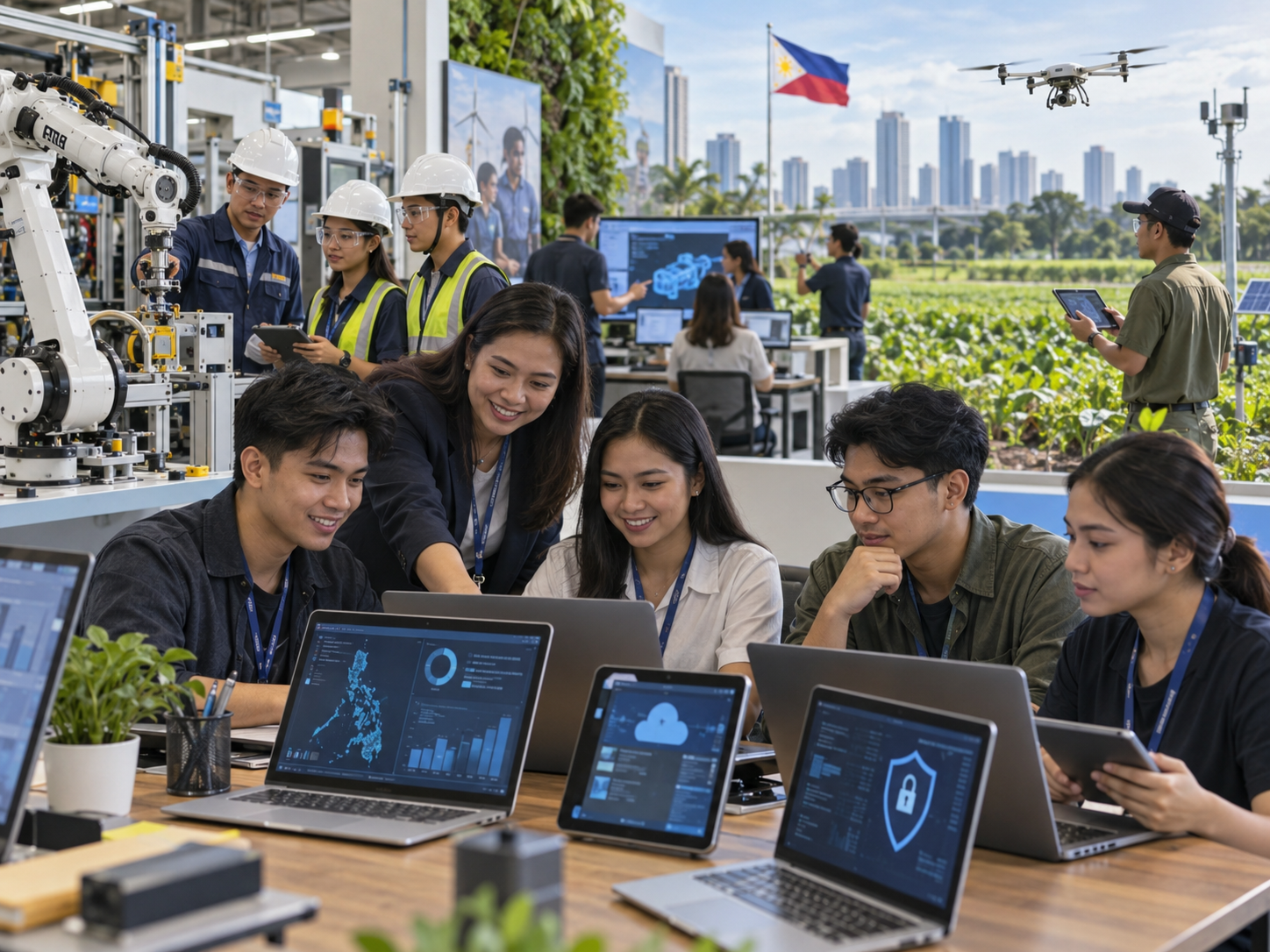
The industry’s response has been to pivot toward “AI-enabled workforce” development, with IBPAP and operators investing in upskilling for non-voice, knowledge-based services. The constraint is not ambition but throughput: government-funded AI programs currently cover only a small fraction of the workforce, and the education pipeline still produces too few graduates with data, cloud, and cybersecurity competencies.
The Nearshoring Proposition Is Changing, Not Disappearing
For US and European clients, the Philippine nearshore value proposition is evolving from “English at low cost” to “time-zone overlap, cultural affinity, and a deep bench of process expertise.” That is a harder sell to procurement teams optimizing purely on labor arbitrage, but a stronger one for clients who need resilient, AI-augmented operations rather than disposable headcount.
The risk is complacency. Vietnam is emerging as a more serious competitor with a strong education system, and Latin American nearshore hubs are closer to US buyers. The Philippines’ advantage in 2026 is not that it is cheapest—it is that it has the deepest operational maturity in English-language service delivery. Whether that maturity survives the AI transition depends on how quickly the industry converts its 1.9 million workers into 1.9 million continuously learning problem-solvers.










Leave a Reply