

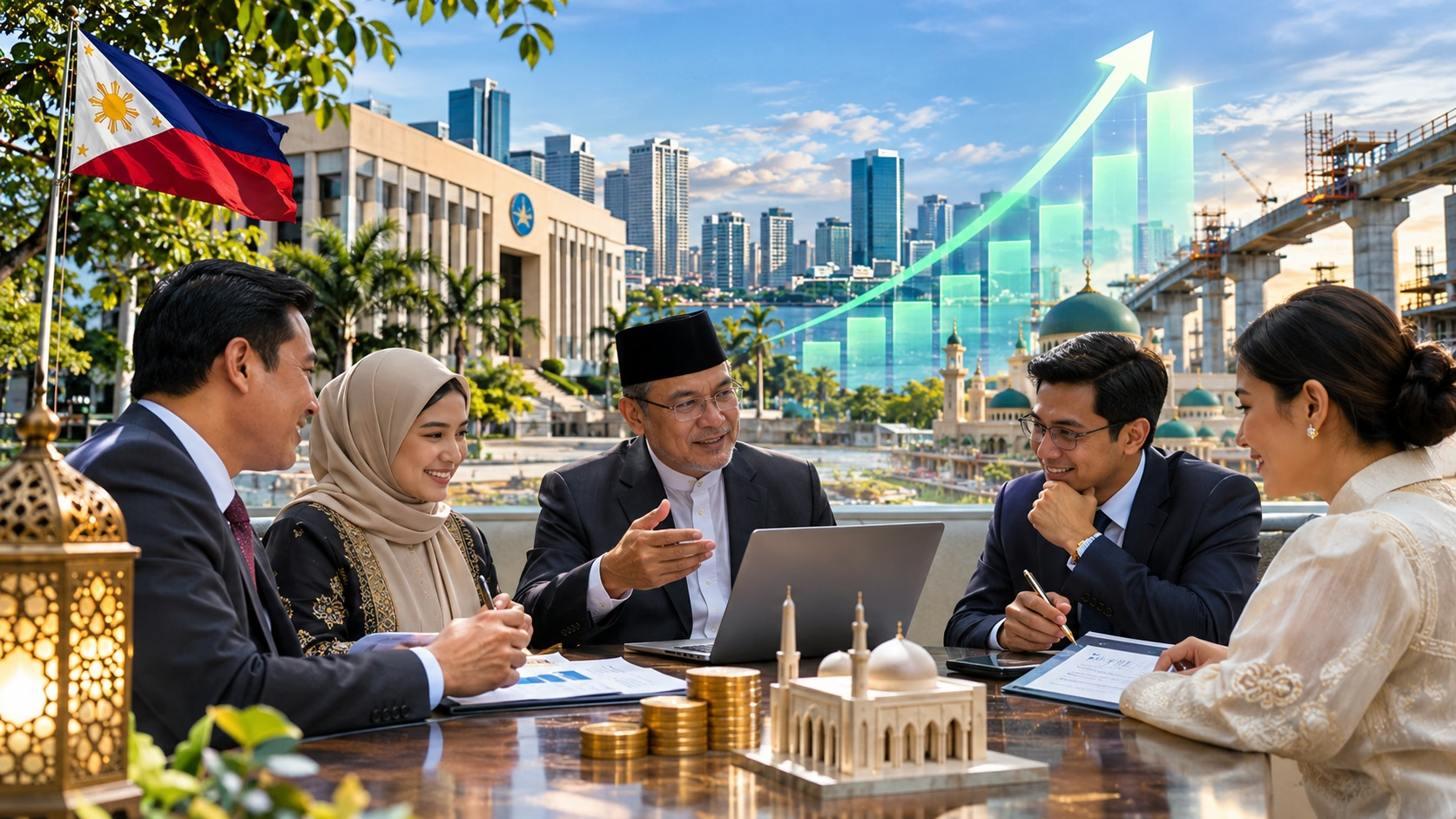
The Ground-Level Architecture of Islamic Finance
The national conversation about Islamic banking in the Philippines is dominated by sukuk circulars, reserve requirements, and single borrower’s limits—the plumbing of capital markets. But the more consequential experiment is happening several hundred kilometers south, where the Bangsamoro Autonomous Region in Muslim Mindanao (BARMM) is building the demand side of the market from the ground up. At the center of that effort sits Al-Amanah Islamic Investment Bank of the Philippines (AAIIBP), the country’s oldest Islamic bank and, until recently, its only one.
In 2026, AAIIBP shifted from institutional survival to ecosystem-building. The bank signed and operationalized partnerships across BARMM’s ministerial machinery, moving Islamic finance from a niche product line into the delivery channels of agricultural and MSME policy. The logic is straightforward: a Muslim population estimated at 6 to 10 million has extremely low Islamic banking penetration, and the BARMM’s Islamic Finance Roadmap 2024–2028 treats Shari’ah-compliant finance as an instrument of poverty reduction and regional stability.
MAFAR and the Financing of Food Security
The most structurally significant partnership is with the Ministry of Agriculture, Fisheries, and Agrarian Reform (MAFAR). In June 2026, MAFAR and AAIIBP strengthened an existing collaboration to expand Shari’ah-compliant financing for Bangsamoro farmers, fisherfolk, and cooperatives, with officials meeting on June 10 to streamline loan processes, improve fund management, and ensure the long-term sustainability of the facility. The significance is not simply the volume of financing but the design: agricultural credit in the Philippines has historically struggled with repayment cycles tied to harvests and the prohibitions on interest that make conventional microfinance structurally unsuitable for observant Muslim borrowers. A Shari’ah-compliant facility embedded within the agriculture ministry’s extension system addresses both the cost of credit and the legitimacy problem.
Basilan and the MSME Test Case
A second front opened in Basilan, where the Ministry of Trade, Investments and Tourism (MTIT)-Basilan partnered with AAIIBP to expand Shari’ah-compliant financing for micro, small, and medium enterprises in Sumisip. The program, implemented through the Propelling Enterprises and Sustainable Opportunities (PESO) initiative, combines a three-day entrepreneurship training—covering the 4 Ps of marketing, unit cost calculation, financial bookkeeping, and business pitching—with access to P20,000 to P500,000 in financing through Qard Al-Hasan and Wakala facilities. Qard Al-Hasan is a benevolent, interest-free loan requiring repayment of principal only, while Wakala is an agency-based arrangement in which one party appoints another to manage a specified investment or financing activity under agreed terms.
The structure matters because it tests whether Islamic microfinance can be commercially repeatable rather than donor-dependent. By bundling financial literacy with Shari’ah-compliant products, the program creates borrowers who understand both the cash-flow logic and the contractual logic of what they are signing—a critical missing link in markets where Islamic finance is often perceived as a religious label rather than a distinct financial discipline.
The Credibility Infrastructure
The Bangsamoro effort is also building the legitimacy layer that Islamic finance cannot function without. In March 2026, the Bangsamoro Darul-Ifta’ (BDI), the region’s highest religious authority, formalized a partnership with M&T Consultants to advance and uphold the integrity of Islamic finance, including capacity-building for ‘Ulamā and the development of Shari’ah audit and accounting expertise. The BDI executive director framed the collaboration as aligned with the principle of Moral Governance, while the consultant emphasized that Islamic finance is not Islamic finance without a valid, legitimate, and credible opinion of ‘Ulamā.
That clerical and technical infrastructure is what separates a durable Islamic finance ecosystem from a product-launch exercise. The BSP has cleared the runway for sukuk and opened the door to more Islamic banks; the Bangsamoro is building the borrowers, the religious authorities, and the delivery channels that will determine whether those instruments find real economic demand. If the BARMM experiment works, it will not be because of a circular from Manila—it will be because a farmer in Maguindanao and a sari-sari store owner in Sumisip found a financial product they could use without compromising their faith.










Leave a Reply